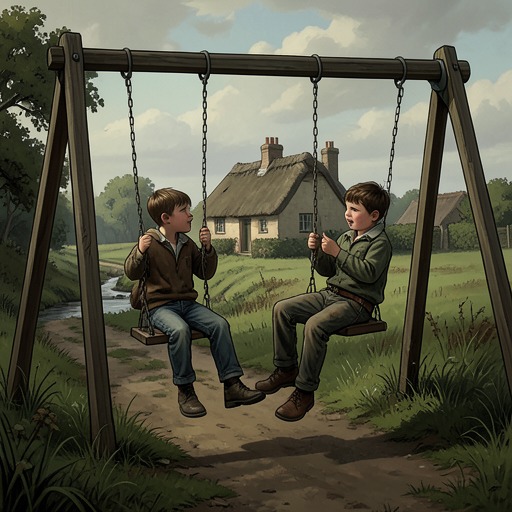
Oliver McCourt and Eugene McCourt’s twin-brother relationship
Angela's AshesOliver McCourt and Eugene McCourt’s twin-brother relationship is defined by shared early life, separation through illness, and the grief that follows each boy’s death. The narrative first presents them as small children growing up together in a family struggling with poverty and inadequate living conditions. When Oliver is taken away for hospital care, Eugene’s attachment becomes visible in his efforts to find his brother; after Oliver dies, Eugene also dies of pneumonia, six months later. Their story makes the twins’ closeness inseparable from the conditions that leave the family vulnerable to illness and loss.
Shared Childhood
Oliver and Eugene are introduced as active young twins, able to stand and walk, but still dependent on their family’s care. The boys have frequent accidents and become sick after putting dirty objects in their mouths. Their mother, Angela McCourt, says the children are driving her crazy; she dresses the twins, places them in the pram, and sends them to the playground with their older brothers, Frank McCourt and Malachy McCourt. The scene places the twins within ordinary family routines, while showing how much care their early years require.
The account situates their childhood in material hardship rather than treating their illness as an isolated misfortune. Their family’s living space is crowded and exposed to damp and poor sanitation. After moving into a house in Limerick, the family discovers that a neighbor empties a bucket into the lavatory outside their door. Later, the lavatory’s persistent use, flooding, flies, and rats become part of the conditions of daily life. The narrative does not identify these surroundings as the direct cause of either twin’s death, but it establishes the hazardous environment in which the children grow up.
Oliver’s Illness and Separation
One morning, the twins’ father, Malachy McCourt, prepares the fire, tea, and bread before telling Frank that Oliver is sick and must go to hospital. He asks Frank to look after his brothers while the parents take Oliver away. As Angela wraps Oliver in a coat, Eugene stands on the bed and asks for him, saying that he wants Ollie to play. The departure makes the brothers’ bond legible through Eugene’s immediate protest against their separation.
After Oliver is gone, Eugene watches from the bed and refuses the bread offered by Malachy. He crawls to the place where Oliver had slept beside Angela and looks out the window. Later, his grandmother gives him water and puts him to bed, reassuring him that Oliver will come home and that they will play together again. This reassurance preserves the expectation of reunion for a time, even as Oliver’s illness becomes a source of fear for the household.
Grief and Eugene’s Search
Oliver dies, but Eugene is too young to understand what has happened. When he wakes, he calls for Ollie and searches around the room, looking under beds and pointing toward children in the street, especially fair-haired children resembling himself and his twin. Angela picks him up and holds him while she sobs; Eugene struggles to get down because he wants to continue looking for Oliver. His repeated search gives the loss a distinct shape: the older family members know Oliver is dead, while Eugene’s actions continue to express the expectation that his brother can be found.
The contrast between what Eugene understands and what the family knows intensifies the scene’s account of bereavement. The narrative does not give Eugene an explanation of death or a developed verbal response to it. Instead, it shows his calls, movement through the room, and attention to children outside. Angela’s embrace cannot satisfy his search, and the attempt to comfort him takes place alongside her own grief.
Eugene’s Death
Six months after Oliver’s death, Eugene is found cold in bed on a November morning. Dr. Troy identifies pneumonia as the cause of death and asks why Eugene had not been taken to hospital sooner. Malachy and Angela say they did not know how serious his condition was. The doctor says that children die when people do not know what is wrong, and instructs the parents to bring Frank or Malachy for treatment at the slightest sign of a cough or rattling in the throat. He also tells Angela to keep them dry, noting a weakness in the family’s chests.
Eugene’s death follows Oliver’s by half a year, but the account distinguishes the circumstances: Oliver’s illness prompts a hospital trip, while Eugene dies at home after his condition has not been recognized in time. The doctor’s instructions turn the loss into an urgent warning about the surviving boys’ health. He expresses sympathy for Angela and says that God is asking too much, too damn much. The twins’ story thus ends not with a reunion but with successive deaths, a mother’s grief, and a heightened fear for the children who remain.
Narrative Significance
The twins’ relationship is conveyed through concrete acts of attachment rather than through an extended account of their personalities. Eugene’s request to play with Oliver, his refusal of food after Oliver leaves, and his repeated search after Oliver’s death establish the emotional force of their bond. The narrative’s focus on these small actions also marks the difference between a child’s experience and adult knowledge: Eugene searches because he cannot comprehend the loss that the others already know.
Their deaths also connect intimate family grief to the wider conditions of childhood in the book. The account places the twins amid sickness, damp housing, poor sanitation, and limited recognition of illness, then shows a doctor warning the family to respond quickly to even slight symptoms. It does not claim that the household’s conditions alone explain the deaths; instead, the sequence makes vulnerability and uncertainty part of the twins’ shared history. Oliver’s absence first becomes Eugene’s unanswered search, and Eugene’s death then makes that separation permanent.